Thursday, 30 April 2015

6 Investing Lessons From The Richest Man In The World- Warren Buffett

buffet-quote
Warren Buffet, also known as the oracle of Omaha, is no stranger to the world of investing. There’s a lot to learn from the most successful (and did we also mention, the richest) man in the world of investing.
Here are six lessons from Warren Buffett that you can use to invest better.
#1: “If you buy things you don’t need, you will soon sell things you need.”
You can make more money not only by investing or taking up a second job, but also by resisting the temptation to go out and just splurge. As the saying goes – a penny saved is a penny earned.
Key Takeaway: To be a successful investor, you need to use due diligence. Spending wisely is not about being miserly, but about being smart. Invest in assets that give you good returns over the long term- one that helps you secure your financial future.
#2: “Price is what you pay. Value is what you get.”
Most of us know this- the money we pay for something and the value we get out of it, most of the time, does not have a correlation. You could possibly buy a posh apartment for 1 crore rupees. But staying in the apartment does not guarantee a high quality of life- does it?
When it comes to investing, especially the stock markets, the price of a stock is mostly governed by market sentiments and not necessarily by the profitability or value of the company itself. Warren buffet suggests to buy stocks when the price you have to pay for the stock is less than the intrinsic value of it. He says, “Whether we’re talking about socks or stocks, I like buying quality merchandise when it is marked down.”
Key takeaway: Instead of trying to time the market and extract every rupee profit you can possibly get out of your investment, invest in assets that will generate inflation-beating long term returns and hold on it for a long time (In buffet terms, forever).
#3: “It’s far better to buy a wonderful company at a fair price than a fair company at a wonderful price.”
Warren Buffet recommends investing in undervalued stock with great potential and holding on to them forever. In-line with this philosophy (which undoubtedly worked so well, and still continues to work), buying shares of a wonderful company at a fair price is much better than buying a mediocre company at a cheap/bargain price.
Buffet notes that over the long term, mediocre companies gives much lesser returns compared to wonderful companies, so much so that the bargain price for which you bought the mediocre company stock does not seem like a bargain anymore.
Key takeaway: Don’t try and time the market or buy into NFO mutual funds because the NAV is low. Invest whenever you have the money and hold it for as long as possible.
#4: Be loss-averse
Majority of investor’s measure performance solely based on return. Buffett advices that you should not strive to make every dollar a potential profit which involves too much risk. Instead you should be loss-averse. Preserving your capital should be your top goal. By avoiding losses you’ll naturally be inclined towards investments with assured returns.
As Warren Buffet puts it, “Rule #1, never lose money. Rule #2, never forget Rule #1.”
The takeaway: While Buffet talks about safety of capital, he’s referring to stock investing where you don’t become greedy and go after too-good-to-be-true stocks. Instead, you focus on stocks that are undervalued and are of companies that you understand and has long-term potential.
Many investors misunderstand this as a recommendation for investing only in Bank FDs or equivalent assets which are mostly considered safe. Investing in Bank FDs is almost always guaranteed to be a losing proposition over the long term since after-tax, the returns you get annualized are below inflation rate.
#5: Be tax savvy
Like all billionaires, Buffett too is tax savvy.
Be knowledgeable about tax laws and use them to your advantage. Before you invest, make sure you understand the tax implications of your investment.
For e.g. while investing in Bank FDs might give you 9% returns, the interest is actually taxable as per your tax-bracket. The real return, if you are in the 30% tax-bracket, will fall to just a little above 6%. Now, that’s below inflation rate and you are effectively losing money the longer you invest in it.
The takeaway: Understand the tax implications of your investment fully before making a choice.
#6: Limit what you borrow
More is not always good- case in point, loans and credit card debt.
With daily offers from ecommerce companies, it might be tempting to buy that latest mobile phone on an EM. Considering the fact that the phone you bought for EMI (plus the processing fee which is in-directly the interest you pay for the EMI facility), and it loses its value over time (most cases, the moment you buy it), it is best if you limit your borrowing.
The takeaway: Borrow only when it’s absolutely necessary. When borrowing, make sure you understand all the fees associated with it. Sometimes, the real cost of bowing money will be hidden as miscellaneous charges like processing fee.
Investing is easier than you think. Take control of your money and start investing like a professional. Create a free Scripbox account and join 1000s of other investors who have automated their investments.

Labels: , , , , , , , , ,

Wednesday, 29 April 2015

How to Better Manage Your Cash Flow

How to Better Manage Your Cash Flow
These four steps will help you keep track of the money coming in and out of your growing company.

Cash is king when it comes to the financial management of a growing company. The lag between the time you have to pay your suppliers and employees and the time you collect from your customers is the problem, and the solution is cash flow management. At its simplest, cash flow management means delaying outlays of cash as long as possible while encouraging anyone who owes you money to pay it as rapidly as possible.
Measuring Cash Flow 

Prepare cash flow projections for next year, next quarter and, if you're on shaky ground, next week. An accurate cash flow projection can alert you to trouble well before it strikes.
Understand that cash flow plans are not glimpses into the future. They're educated guesses that balance a number of factors, including your customers' payment histories, your own thoroughness at identifying upcoming expenditures, and your vendors' patience. Watch out for assuming without justification that receivables will continue coming in at the same rate they have recently, that payables can be extended as far as they have in the past, that you have included expenses such as capital improvements, loan interest and principal payments, and that you have accounted for seasonal sales fluctuations.
Start your cash flow projection by adding cash on hand at the beginning of the period with other cash to be received from various sources. In the process, you will wind up gathering information from salespeople, service representatives, collections, credit workers and your finance department. In all cases, you'll be asking the same question: How much cash in the form of customer payments, interest earnings, service fees, partial collections of bad debts, and other sources are we going to get in, and when?
The second part of making accurate cash flow projections is detailed knowledge of amounts and dates of upcoming cash outlays. That means not only knowing when each penny will be spent, but on what. Have a line item on your projection for every significant outlay, including rent, inventory (when purchased for cash), salaries and wages, sales and other taxes withheld or payable, benefits paid, equipment purchased for cash, professional fees, utilities, office supplies, debt payments, advertising, vehicle and equipment maintenance and fuel, and cash dividends.
"As difficult as it is for a business owner to prepare projections, it's one of the most important things one can do," says accountant Steve Mayer. "Projections rank next to business plans and mission statements among things a business must do to plan for the future."
Improving Receivables 
If you got paid for sales the instant you made them, you would never have a cash flow problem. Unfortunately, that doesn't happen, but you can still improve your cash flow by managing your receivables. The basic idea is to improve the speed with which you turn materials and supplies into products, inventory into receivables, and receivables into cash. Here are specific techniques for doing this:
·         Offer discounts to customers who pay their bills rapidly.
·         Ask customers to make deposit payments at the time orders are taken.
·         Require credit checks on all new noncash customers.
·         Get rid of old, outdated inventory for whatever you can get.
·         Issue invoices promptly and follow up immediately if payments are slow in coming.
·         Track accounts receivable to identify and avoid slow-paying customers. Instituting a policy of cash on delivery (c.o.d.) is an alternative to refusing to do business with slow-paying customers.
Managing Payables 
Top-line sales growth can conceal a lot of problems-sometimes too well. When you are managing a growing company, you have to watch expenses carefully. Don't be lulled into complacency by simply expanding sales. Any time and any place you see expenses growing faster than sales, examine costs carefully to find places to cut or control them. Here are some more tips for using cash wisely:
·         Take full advantage of creditor payment terms. If a payment is due in 30 days, don't pay it in 15 days.
·         Use electronic funds transfer to make payments on the last day they are due. You will remain current with suppliers while retaining use of your funds as long as possible.
·         Communicate with your suppliers so they know your financial situation. If you ever need to delay a payment, you'll need their trust and understanding.
·         Carefully consider vendors' offers of discounts for earlier payments. These can amount to expensive loans to your suppliers, or they may provide you with a change to reduce overall costs. The devil is in the details.
·         Don't always focus on the lowest price when choosing suppliers. Sometimes more flexible payment terms can improve your cash flow more than a bargain-basement price.
Surviving Shortfalls 
Sooner or later, you will foresee or find yourself in a situation where you lack the cash to pay your bills. This doesn't mean you're a failure as a businessperson-you're a normal entrepreneur who can't perfectly predict the future. And there are normal, everyday business practices that can help you manage the shortfall.
The key to managing cash shortfalls is to become aware of the problem as early and as accurately as possible. Banks are wary of borrowers who have to have money today. They'd much prefer lending to you before you need it, preferably months before. When the reason you are caught short is that you failed to plan, a banker is not going to be very interested in helping you out.
If you assume from the beginning that you will someday be short on cash, you can arrange for a line of credit at your bank. This allows you to borrow money up to a preset limit any time you need it. Since it's far easier to borrow when you don't need it, arranging a credit line before you are short is vital.
If bankers won't help, turn next to your suppliers. These people are more interested in keeping you going than a banker, and they probably know more about your business. You can often get extended terms from suppliers that amount to a hefty, low-cost loan just by asking. That's especially true if you've been a good customer in the past and kept them informed about your financial situation.
Consider using factors. These are financial service businesses that can pay you today for receivables you may not otherwise be able to collect on for weeks or months. You'll receive as much as 15 percent less than you would otherwise, since factors demand a discount, but you'll eliminate the hassle of collecting and be able to fund current operations without borrowing.
Ask your best customers to accelerate payments. Explain the situation and, if necessary, offer a discount of a percentage point or two off the bill. You should also go after your worst customers-those whose invoices are more than 90 days past due. Offer them a steeper discount if they pay today.
You may be able to raise cash by selling and leasing back assets such as machinery, equipment, computers, phone systems and even office furniture. Leasing companies may be willing to perform the transactions. It's not cheap, however, and you could lose your assets if you miss lease payments.
Choose the bills you'll pay carefully. Don't just pay the smallest ones and let the rest slide. Make payroll first-unpaid employees will soon be ex-employees. Pay crucial suppliers next. Ask the rest if you can skip a payment or make a partial payment.

Labels: , , , , , , , ,

Tuesday, 28 April 2015

Steve Jobs vs. Bill Gates / Apple vs. Microsoft

            Steve Jobs vs. Bill Gates / Apple vs. Microsoft

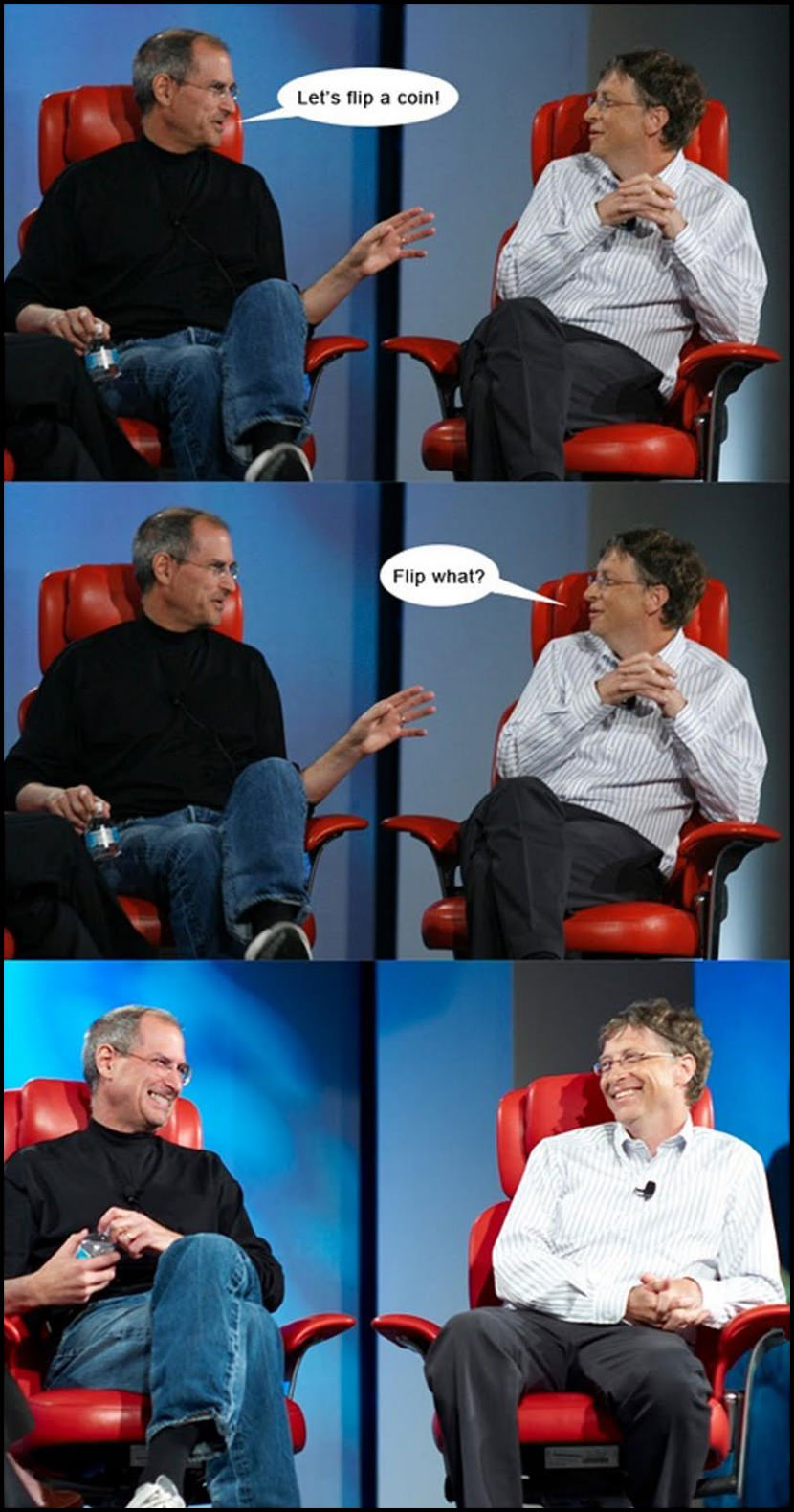
  • Flip A Coin

They both probably use Credit Cards or a personal assistance that will always be at their side attending to their needs.
Flip A Coin

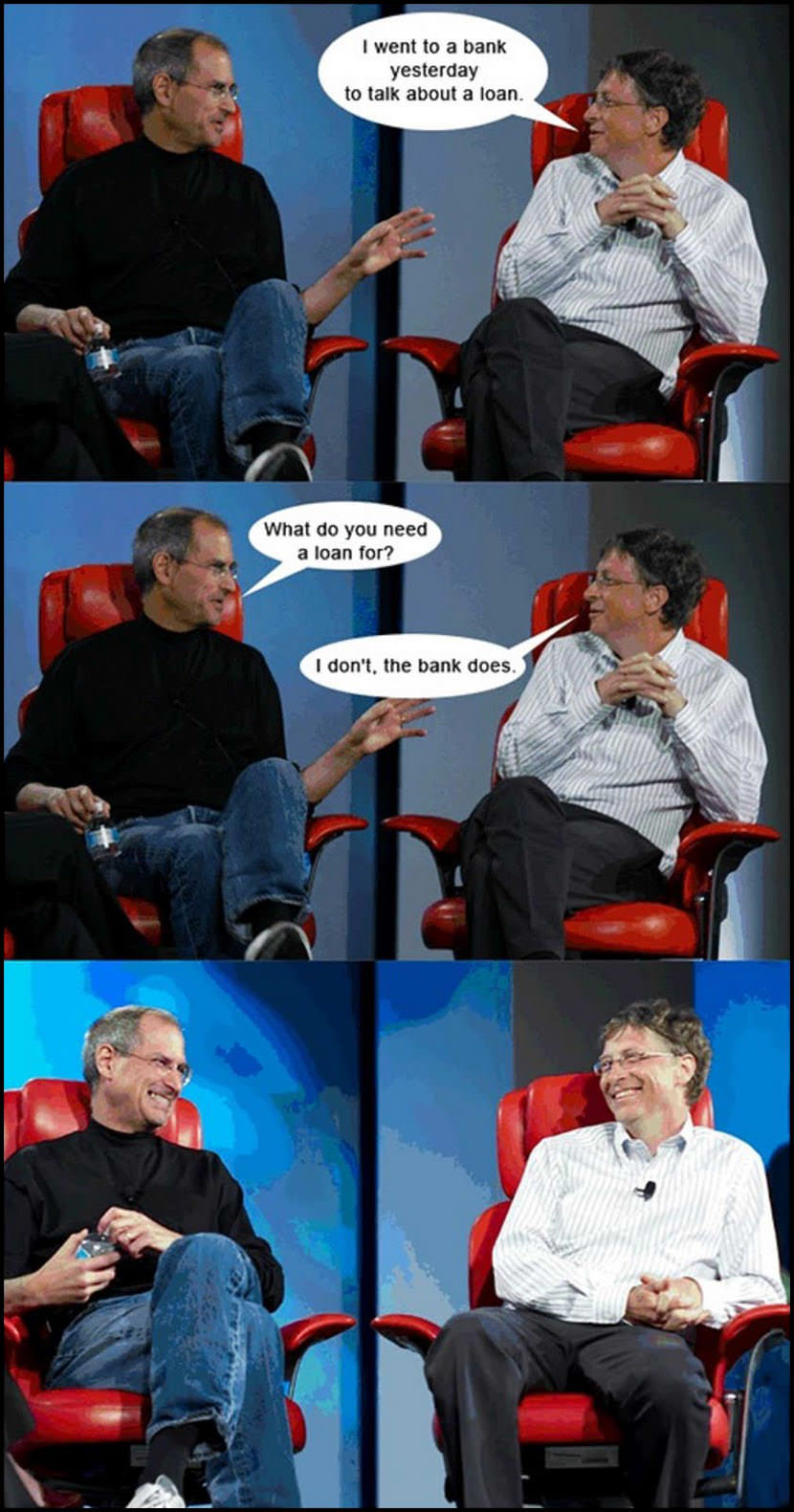
  • Bank Borrowing From Bill Gates

Bank Borrowing From Bill Gates

  • Bill Gates Nobel Prize

For those that doesn’t get this joke, for your information, Bill Gates is not the biggest share holder of Microsoft, he has been selling down his share in Microsoft for many years and have invested his wealth in medical and services industries such as Four Season hotels.
For those that doesn't get this joke, for your information, Bill Gates is not the biggest share holder of Microsoft, he has been selling down his share in Microsoft for many years and have invested his wealth in medical and services industries such as Four Season hotels.
  • Penguins

Linux’s official mascot is a penguin.
Linux's official mascot is a penguin.

  • Cannibalism

Who wants to be a millionaire TV show.
bill gates steve jobs Cannibalism

  • Saving Money To Buy A House

How much Bill Gates make per minute? Bill Gates is worth of $72 billion, a 6% rate of return would earn Gates roughly $114.16 per second he is alive, making it a poor investment for Bill Gates to bother picking up a $100 bill if he dropped it. For 5 minutes, he could have bought a simple apartment at USD34K.
Bill Gates is worth of $72 billion, a 6% rate of return would earn Gates roughly $114.16 per second he is alive, making it a poor investment for Bill Gates to bother picking up a $100 bill if he dropped it.

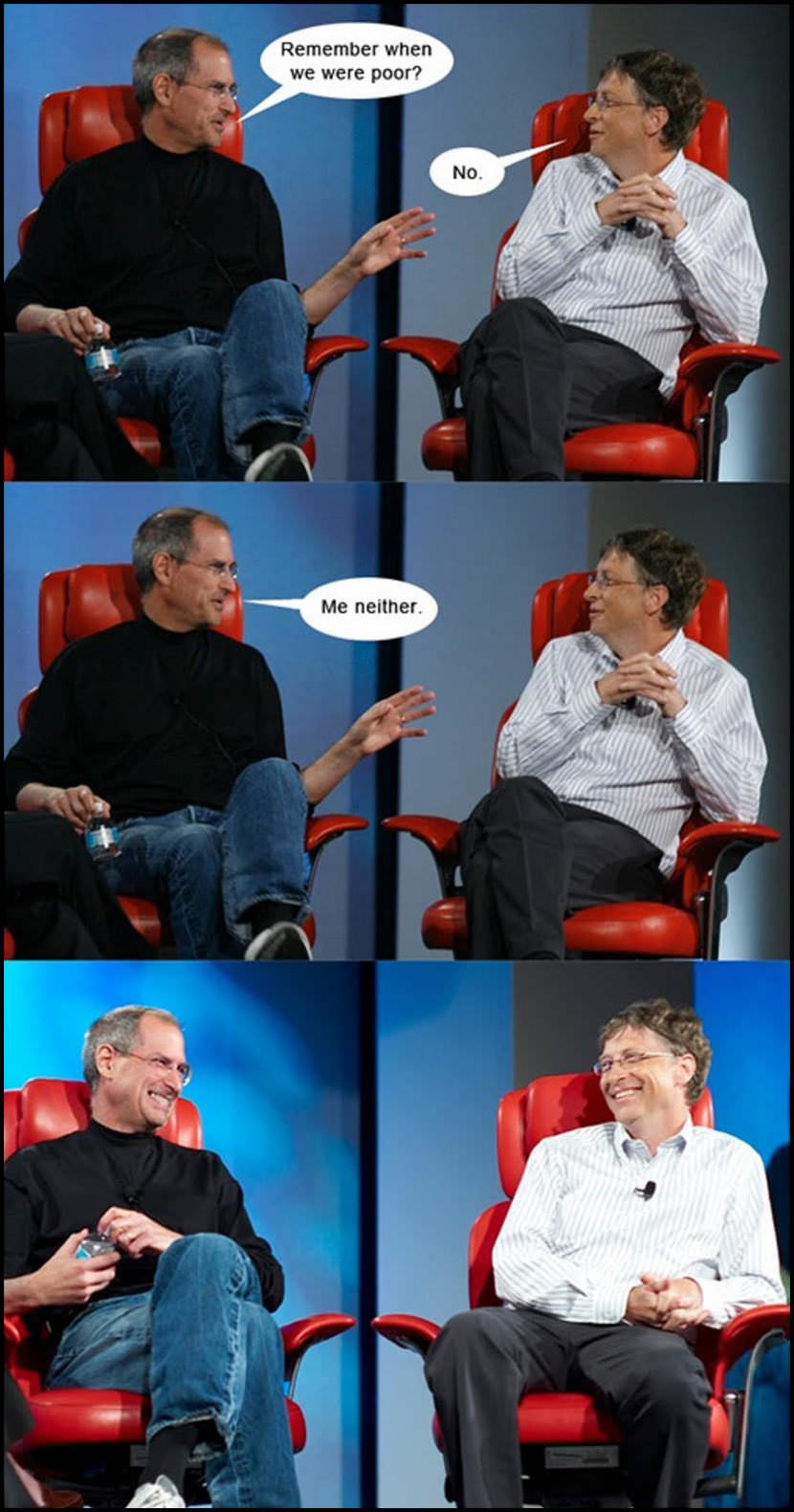
  • On Being Poor

Steve Jobs comes from a middle class family while Bill Gates comes from a upper class family.

Steve Jobs and Bill Gates Together in 2007 at D5

Bill Gates and Steve Jobs are interviewed live together at the D5: All Things Digital conference. In this historic conversation, Jobs and Gates are asked to comment on each other’s greatest contributions to digital technology, as well as what they perceive.

Labels: , , , , , , , , , , , , , , , , , , ,