Thursday, 30 April 2015

Announcement: Tired of feeling stuck? Let go of the past and create a life you love with the Tiny Buddha course! When Your Dream Dies and You’re Not Sure What to Do Next

Woman with Guitar

“You are never too old to set another goal or to dream a new dream.” ~C. S. Lewis
My wake-up call came at a friend’s wedding about seven years ago. Somebody asked me what I did for a living, and I answered truthfully: I’m a singer in a rock band. She thought it was cool, but I went into a rant about why it wasn’t.
“Creative work is definitely more perspiration than inspiration. The constant travelling and playing late night gigs is exhausting. The ‘business’ side of ‘music business’ is a joke,” I fumed.
On and on I went. As you’d expect, she was pretty shocked. But it was her words to me that made me stop in my tracks: “Wow, so much anger!”
What had happened to me? My dream of living off my music had come true. It was a childhood dream of mine, and I was one of the lucky few who were actually living that dream.
Yet, I was angry and bitter. I felt like I wasn’t in control of my own life and my own decisions, because I didn’t own my time, my location, or my money. I felt like my band owned me, because the band always had to come first.
I realized that my dream wasn’t my dream anymore. Something that once filled me with excitement and passion had become a burden. It was time to find a new dream.
These changes are inevitable in life. You might have experienced the same when you’ve had to let go of a big and important dream.
Maybe a relationship proved to be more painful than fulfilling and you had to scrap your big dream of starting a family.
Or maybe starting a family suddenly made your dream job feel meaningless, and spending twelve hours a day at work felt like missing out on something far more important.
Maybe you were a serious athlete and an injury forced you to quit your sport.
These were things that you worked hard for, and making the decision to leave them behind can feel like cutting off the most important thing in your life. Now what?
Finding that next thing to fill the void of the Big Dream proved to be a lot harder than I expected. I experienced grief, emptiness, and a total lack of direction. I felt I was wasting my life.
Suddenly I had all this time in my hands that I could have used for other things, but I didn’t know what those other things were. Everything felt a bit pointless. The big picture was missing.
The dream used to be my goalpost, something that always showed me the direction. Without the dream, I lacked motivation and the reason to do anything.
So how do you dig yourself out of that hole? How do you find that spark again? This is what I did.

Give yourself time.

Give yourself enough time to let the old dream die first. Allow yourself the emotions of grief, anger, depression, and loss. It can be tempting to dismiss those feelings and jump headfirst into a new project, but process the death of the old dream first.
Allow yourself to just be. Take walks, write a journal, spend more time with friends. Empty yourself from your old routine and just live one day at a time.
This can be hard if you are driven and goal-oriented, but sometimes it’s good to give yourself room to clear the table. Allow yourself enough time and space so that your new dream has the space to appear.

Try new things.

Your new direction and purpose might be radically different to your old one. Give yourself an opportunity to explore completely new things. Mingle with different people, travel to new places, read books you would have never touched before.
You may find a whole new world that you never had time to discover before because you were so immersed in your old dream. This is the time to give yourself a chance to experience something new.
Don’t force yourself to the next thing. Instead, keep an open mind. What else does this wonderful world have to offer us?

Be honest with yourself.

Spend time in learning more about the person that you truly are. What is it that you really want in life? Have you changed as a person?
It’s so easy to go with what other people say or make decisions based on other people’s expectations. Maybe things broke down for a very good reason. Your old dream didn’t serve the person you are now.

Re-define the dream.

Ask yourself brutally honest questions. What does real success look like for you? What is it that truly makes you happy?
Maybe you want more time, not more money. Maybe you crave more freedom, not a more demanding job. When you become really clear about what is important to you in life, you will find the first clues about what your new dream will look like.
For me, it was incredibly important to let go of the old dream that didn’t serve me anymore. Feeling angry and bitter is far worse than feeling lost and empty for a while. Change is difficult, but enduring a period of pain is the path to turning things around.
Sometimes the new dream and the new direction can be found in the most unexpected of places, but that’s what starting over is all about.
It took me a while to find my mojo again, but once I did I felt like anything was possible again. Life changes, we change as people; it only makes sense that our dreams change too.
I found a new balance and a new direction when I started to diversify my ideas of success. Achieving the dream shouldn’t be about sacrifice and pain. Instead, it should be about daily joy.
What you do every day is what your life becomes about. The dream is just your idea of the future. Focusing on enjoying the every day will lead you to that next Big Dream that is right for you.

Labels: , , , , , , , , , ,

On fun-sized advice

I fell in love with my best friend and its not working out. What now?
Disaster.


I’m a nine. He’s a four. Why is he blowing this off?
Because you act like you think you’re a nine and he’s a four.


How do I know if the relationship is unhealthy or I’m unhealthy for the relationship?
That’s a distinction without a difference.


I can’t remember the last time I was sober for more than two days.
Yes you can. What changed?


I thought I knew this but maybe I was wrong. What is the difference between race, ethnicity, and nationality?
Race is a social construct that groups people according to inherited genetic characteristics. Ethnicity is a social construct that groups people according to inherited cultural characteristics. Nationality is a social construct that groups people according to inherited political characteristics.


As a white person, how can I enjoy black culture without culturally appropriating? Can I? 
What did your black friends say when you asked them this question? (Yeah, that was a trick. Anyone who would ask this doesn’t have any black friends.)


Hypothetical; you’re in a position in which you could solve the Israel-Palestine conflict indefinitely. You would get the credit (so Nobel Peace Prize etc etc). HOWEVER, you would never be able to have an orgasm again. What do you do?
I solve the conflict with no hesitation whatsoever. Fuck the credit. (What kind of monster puts their own orgasms ahead of lasting peace in the Middle East?)


How does it feel being Facebook-free for over 4 years?
People still use Facebook? I thought that’s just where our crazy aunts posted racist memes about Obama.


Do you consider yourself a celebrity?
Hell no. I consider myself a pop culture enthusiast. On a good day, I consider myself a writer.

Labels: , , , , , ,

It’s Okay to Not Be Okay

It’s Okay to Not Be Okay

By C. De Lima
Sad Woman
“Love yourself—accept yourself—forgive yourself—and be good to yourself, because without you the rest of us are without a source of many wonderful things.” ~Leo F. Buscaglia
In 2009 I traveled to Perth, Western Australia, to further my education. Little did I know how much my life would change.
I befriended lots of people and met a tall, gorgeous man from South Asia. He was not the type of guy I normally dated, but I fell for him anyway.
It was our happy fun time in 2010. Then, in early 2011, I sensed a change.
It’s funny when you’re in a relationship with someone; you can feel when something just isn’t right. 
I had that feeling.
You see, ever since we became a couple, we could talk about anything without feeling judged or embarrassed. We were happy, so when suddenly he changed and became very private, it raised an alarm in me.
It turned out he was having an affair—not just with one, but with two women at the same time. The pain, the hurt, the humiliation, and the numbness that came afterward were unbearable.
I literally forced the truth out of him. I knew it would hurt, but I had to know his reasons. How could someone with a kind heart cheat on a person and create a new relationship based on a lie? Questions bounced around in my head for months.
Eventually I forgave him, and so did the others. But unfortunately for me, I let myself stay in this drama.
I latched myself to him—and lost myself—while feeling confused by his conflicted feelings toward me, between “I want you” and “I don’t.”
It’s a strange thing, but sometimes it can feel safer to stay with a pain we know than embrace the pain of walking away.
That was when I found out I was six weeks pregnant.
Under stress and feeling mentally and physically tired, not to mention scared, I decided to keep the pregnancy as a single mother. Then I miscarried in the first week of December. It completely broke my heart.
Honestly, I was already feeling numb and I thought, “This is it. This is the limit.”
Unfortunately it wasn’t, because five days after my miscarriage, during a follow-up at the hospital, a doctor asked me, “Did the other doctors say anything about your left ovary?”
He then referred me to the radiology department, and they supported my doctor’s diagnosis—an eight centimeter tumor on my left ovary that had to be removed immediately. Since there are cancer genes on my mother’s side of the family, this was an even greater cause for concern.
I left the hospital feeling numb. Numbness turned into anger.
My sister and best friend called and said it was okay for me to get angry, releasing all the pain inside.
By the end of the day, I didn’t have any energy left. I felt so drained.
The worst thing about being alone is feeling you are alone.
All I wanted at that time was to go home, where I could just rest without thinking about how unfair life feltat that moment.
So in mid-December I flew back to Indonesia and had the surgery a couple of days later. Sadly, they couldn’t save my left ovary, but I felt safe and loved with my mother and sister comforting me. I could finally share my burdens with them.
I didn’t have the man I loved, and yet there was still so much love in my life.
The pathology results from the tumor stated benign, but since I have the cancer genes, I have no option but to change my lifestyle and make healthier choices, which is a blessing already.
While taking the time to recover from my heartbreak, my loss, and my surgery, I managed to celebrate Christmas and the New Year with my whole family who supported me and welcomed me back with open arms.
I’m not completely okay, but I’m still standing.
Last year, I thought I was happy, but I realized in retrospect that I’d lost myself in my relationship. Then when I lost my baby, I thought that I’d lost everything.
And yet if it weren’t for that miscarriage, I wouldn’t have learned about the tumor.
Sometimes the worst things in life can actually be blessings in disguise.
In retrospect, I realize I made a lot of mistakes. I stayed in a relationship even though I knew it was one-sided, because I didn’t have the courage to walk away. I lied to myself so I didn’t have to accept what happened.
But I’m learning to forgive and take care of myself, mentally and physically.
And I’m finally accepting that it’s okay to not be okay.
It’s okay to cry for our losses. It’s okay to mourn the dreams that didn’t pan out. It’s okay to hurt and not have things figured out.
Through the events in our lives, good and bad, we learn who we are and what makes us tick. It’s not about creating happily ever after—it’s about taking it one step at a time and accepting that we’ll go through times when we won’t feel happy.
I never imagined I would lose love, a pregnancy, and my health all in one go. But even if I don’t feel okay right now, I know I will be okay because I have family and friends who love me unconditionally.
But most importantly, I love and believe in myself.
And as for my past lover, I hope he will find the change that he still seeks and desires, and that he never breaks another woman’s heart the way he did mine.
Remember: everything will be okay if we love and believe in ourselves, and understand that hope floats around us.

Labels: , , , , , , ,

To heal a broken heart…

In most relationships, we are living an illusion, choosing to skim over the sootier bits ­ till reality strikes forcefully
Much like pieces of flotsam, our thoughts and emotions float all over the place, skimming, attaching and detaching from experiences, things and people. For a while, we connect with something or someone, becoming dependent on each other for happiness and peace of mind.
Our entire world is encompassed by that new connect and we give it the name of romance or love.  ­ Every waking thought focusses on the person we thus connect to, every emotion cries out to be shared, and every moment seeks that special connect. The happier the moments shared, the stronger becomes the bond and dependence. We sugarcoat and push to the bottom a lot of reality we would rather not deal with. In most relationships, we are living an illusion, choosing to skim over the sootier bits ­ till reality strikes forcefully.
As with the original umbilical cord, the time comes to be separated. We have fed enough on our experience with that person and both must move on in our individual journeys. This may or may not signify the end of a relationship, but it surely spells a tectonic shift. One moves on. Almost always this is not a conscious decision, but imposed and painful, as all separations are. However, the experience always leaves us wiser and richer ­ either because of the positivity it gave us, or the way its negativity strengthened us.
And so, for a while, you get thrown out into the cold, till you gather yourself again and the healing begins. Soon you are ready to dive back into life again with renewed vigour and determination.
However, what happens if a person gets stuck in that in-between stage, unable to overcome the pain ­ as happens so often?
Rima Sharma (name changed) is one such person who has been writing to me frequently, unable to comprehend the ending of what she describes as a beautiful and deep relationship. She is particularly upset because the man she was involved with started another relationship while they were still together. It is to Rima that I promised this article.

How nice it would be if she could control her memories and emotions and pull herself out of the painful situation. It is possible if she understands that emotions can be anchored and controlled. But how do you mend what you consider your broken heart?
Well, to begin with, it is important to understand that the heart never gets broken; it may get chipped, but most often the chip you are dealing with is on your shoulder. It is your ego that takes a beating; it is betrayal of faith that you cannot handle, an attachment to the happy memories that refuse to let go. You grab at straws that have floated away. You demean yourself -and then all at once, one small incident serves to wipe away the thin film of illusion that covers the reality underneath -and all the crap comes tumbling out. You have finally faced reality and are ready to push aside the pain and move on.
The secret then to moving on is to focus on what was always wrong with the relationship, rather than what was good about it. It was bad for you, so it broke; relationships that are good for us seldom break in this manner.
Once you understand this, it’s easy to bid a final goodbye ­ because deep within, you always knew how the land lay! And now, rid of the negativities, you realise all the good stuff you were blocking from your life by focussing on a vampire relationship that took more than it gave.
The rest of the tricks to moving on are known to all–­immerse yourself in work and hobbies; hang out with friends; count your blessings; list the things and people important to your well-being; boost your morale, and re-energise yourself by looking your best, walking your tallest and acting your most confident.
Forgive the one who betrayed you, but do not forget the betrayal. Give up on the relationship ­ but never give up on love.

Labels: , , , , ,

Wednesday, 29 April 2015

10 Signs That You Don’t Want to Be Happy in Relationship

1. You keep engaging in the role of being The Other Woman.
2. You only become involved with emotionally unavailable men.
3. You go out with Bad Boys or Bastards in the name of excitement.
4. You keep dating the same ‘type’ that makes you feel miserable.
5. You happily shelve friends and family, especially when the object of your affections is clearly unsuitable.
6. You meet decent, nice men who want to treat you nice and spend time with you and you call them ‘Assholes’ or claim that it must be an act.
7. You want to be in a steady, committed relationship but keep sleeping around or being used sexually by men which further erodes into your self esteem hence stopping you from getting the relationship you want.
8. You do things that involve you willfully self destructing your life.

9. You get the opportunity to break up with the guy that is mistreating you, but you eventually take him back because you don’t value yourself enough and think it’s better to be with him.
10. You actually believe that it’s better to be with somebody, anybody than be alone.

Labels: , , , , , ,

We need to talk about “selfish” (Relationships)

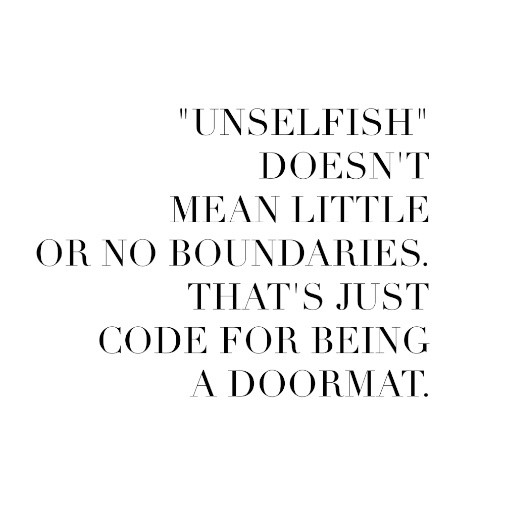
unselfish doesn't mean little or no boundaries. that's just code for being a doormat.
When we suppress and repress our own feelings, opinions, needs, expectations and desires, we become oversensitised to those of others and develop a pesky habit of taking ownership of their feelings and behaviour. It’s as if in silencing us and being on high alert, we think that we’re feeling their feelings and thinking their thoughts, causing us to anticipate and forecast doom while burdening us with ‘duties’.
When we take ownership of other people’s feelings and behaviour, we spend a lot of our time grappling with doubt, guilt and shame. We fear that we are being “selfish” and we also tend to engage with people who feel entitled to our compliance. 
We see it as our responsibility to be and do things that make people feel better… even if it’s to our detriment and even if it means that we are preventing them from taking ownership of their feelings and behaviour… and even if it means that we are avoiding our own responsibilities.
As a result, when we perceive that we’re being requested or expected to do something that takes care of their needs, expectations, and desires, even if it isn’t 1) fair and reasonable and 2) our responsibility, we convince ourselves that to say no or leave them to it, would be “selfish”. We imagine that they’re feeling really bad or thinking whatever and whatever about us. In order to relieve that tension within us and keep up with this image of being what we think is unselfish, we do what they need/want/expect or do what we think that they need/want/expect.
We of course, end up feeling pretty bloody awful because it’s one thing if we are being and doing stuff because it’s truly who we are and without expectation of a reward of some kind, but invariably, we are not being ourselves and we also have an underlying expectation that we should be rewarded in some way, so lack of conflict, criticism, disappointment etc. Really, all we’re doing is operating under the misguided hope that one day somebody will say, “Wow! Isn’t _______ such an altruistic person? Did you know that they’ve thrown themselves under a bus thousands of times? I think it’s time that the universe cut him/her a break and let the good times roll.”
That’s not how it works.
Sometimes we get a tad set in our vision of how we think things ‘should’ be, so we think thatbecause we’re being what we view as unselfish, that we should be cut some slack but we don’t take responsibility for the fact that we may be doing us wrong in the process. So many of us believe that being unselfish means ignoring the self.
Unselfish doesn’t mean little or no boundaries because the reality is, every person who has bad boundaries, on some level expects something in return. They do.
As grownups, our relationships need respect. This means that we cannot be talking about this whole selfish/unselfish malarkey in a dynamic where one party is expected to lack self-respect while the other enjoys what they see as their entitlements and benefits.
It’s not a bad thing to ask stuff of others but it’s a problem when a person feels entitled to compliance and seeks to benefit at the expense of others. It adds insult to injury when they’re met with a NO and then they squawk about people being “selfish”.
No person has a right to expect that because they need, expect, or desire something, that they should be able influence, control or even force others into obliging them. That is selfish.
Life is a journey and our purpose isn’t to go out of our way to create limitations and disadvantages for ourselves. Every time we burden ourselves with false obligations, we are living life to our detriment by using our time, efforts, energies, and emotions in unproductive, self-defeating ways. What we need to do in order to live happily and authentically is figure out and be who we truly are (life is on the job training for this) by healthily benefiting ourselves.
When we treat and regard ourselves with love, care, trust, and respect, this not only benefits us but it also benefits others because we engage in our relationships and various dynamics from a healthy place as opposed to what we can “get out” of people.
When we worry about being selfish, we have to ask:
Will me being and doing something to benefit me, harm others?
Example: Will me having healthier boundaries harm others? Will me having healthier boundaries have an adverse effect on others?
Note, the ‘inconvenience’ of a person not being able to benefit from where we are less than respectful towards us, is not ‘harm’…
If the negative effects of us doing something for somebody isn’t going to outweigh the benefits, we can go ahead… if we want to. It is our choice, not our obligation.
If we bust boundaries, whether it’s our own or those of others, that does cause harm.
If we avoid responsibility or prevent others from experiencing natural consequences, this alsocauses harm.
If we prevent ourselves from evolving or we try to get in the way of others evolving so that we can feel ‘safe’, that also causes harm.
When we think that we’re being selfish or somebody intimates or states this about us, we need to take a step back and ask ourselves: Is the person in question being and doing something to benefit themselves, that is harming me? What is it?
I hear from a lot of people who go No Contact for very valid, healthy reasons and yet they end up excessively worrying about the other person’s feelings while barely considering or taking responsibility for their own feelings and wellbeing. They feel guilty for opting out and not being able to take anymore. They think that they’re “selfish” for needing time to grieve.
It’s not going to harm the other party to break up or even go No Contact from a relationship and interaction that isn’t working. That’s not to say that they won’t be hurt but that’s not a reason to stay. If we respond to this guilt and start doing the whole keeping in touch to make their image stack up, sleeping together or whatever, they benefit and yeah, we experience the illusion of our ego benefiting but actually, this causes us a great deal of harm because we ignore the very real reasons about why we needed to step back and are also now exposing ourselves to further newpain.
It’s also not beneficial to keep placating a person’s ego just so that they don’t have to face up to the end of the relationship or even their actions. We should know – enough of us here at BR have been placated by people who do not want to “feel bad” about ending the relationship or how they have treated us and actually, it messes with our heads. It can be a vicious cycle to keep trying to appease people in order to make ourselves feel better. We need to learn how to do the right, healthier thing by us and take command of us feeling better.
There are always going to be people out there who are OK with being selfish and all we can do is do our best to stay out of their way and to engage with like-minded folk.
Be suspicious of anybody who has a problem with you wanting to evolve through increasing self-knowledge, self-awareness, and self-love. Boundaried people; people who take responsibility for themselves and want to evolve and see those they love and care about evolve, don’t bandy around the term “selfish” or try to guilt others into compliance. If you have an overall pattern of being kind and generous, somebody who respects you, will respect that you have the right to make choices for you when you need to (as do they for themselves), and will trust in you and your relationship rather than focusing on any so-called inconvenience.
Your thoughts?

Labels: , , , , , , , , , , ,

When Sorry Isn’t Enough

Pen writing I am sorry

One of life’s essential leadership skills is the art of the apology.  Part of being human is that we all make mistakes, say the wrong thing, and misread others.  We hurt people sometimes knowingly and sometimes not.
Some people have a difficult time saying, “I am sorry” while others are able to say it freely.

But is sorry enough?


  • Ever hear the words “I am sorry” but it didn’t do it for you?
  • Have you ever apologized to someone only to find that it almost fell flat?
  • What if there was a specific language of apology that changed everything?

Gary Chapman is the author of the 5 Love Languages® series and director of Marriage and Family Life Consultants.  Jennifer Thomas is an author, speaker, and psychologist.  Their new book When Sorry Isn’t Enough taught me why “I am sorry” is often not good enough.  I recently had the opportunity to connect with Dr. Thomas and talk about the art of the apology, relationships, forgiveness and trust.

“Forgiveness holds the power to give renewed life to the relationship.” –Chapman / Thomas

Sorry Isn’t Always Enough


Why did you decide to research and study the apology?
Several years ago, I made a mistake that led to an argument with my husband. Ironically, this incident happened the evening before we were to teach about communication and forgiveness to a pre-marital class at our church.  As he and I worked through our own argument, I offered an apology to him that failed to hit the mark.  I was thinking to myself, “This is not good. We are barely speaking and yet we are supposed to teach together tomorrow.”9780802407047
Normally, I might have been miffed by his response, but this time my curiosity took over and so I asked him what he would like to hear in my apology.  While I had been saying, “I’m sorry,” he needed to hear me say, “I was wrong.”  I hadmade a mistake, and I knew I was in the wrong, so I went ahead and said it to my husband.  I was amazed by how quickly this apology worked. My husband felt better, and the emotional tension between the two of us slipped away.
I made a mental note to include my husband’s favorite words in future apologies I would give to him.  I wondered if our experience might help other people who are in the “doghouse” and don’t know how to get out of there.

The Language of Apology


How did you connect your ideas with Dr. Chapman’s love languages?
I had met Gary Chapman locally through my work as a psychologist in private practice in North Carolina.  I was curious about his thoughts on apologies.  I thought to myself, “Just as you should show love in a language that really speaks to others, you should also speak apologies that contain the words they are waiting to hear.”  Six months later, I made an appointment to talk over these ideas with him.  Dr. Chapman was very encouraging, and we ended up writing a book together.
Gary Chapman and Jennifer Thomas


“Genuine apology opens the door to the possibility of forgiveness and reconciliation.” –Chapman / Thomas

If you are close to someone, it’s inevitable that you’ll need to apologize to them. How can you be prepared to speak their apology language?
Here are a couple of conversation starters that will help you be prepared when the need to apologize arises. Ask the people who are closest to you:
  1. When you hear a great apology, what is included?
  2. When you hear a lame apology, what is missing?
You can also click on my website’s “free resources” tab to take the apology language and love language assessments for free.

“Trust is that gut-level confidence that you will do what you say you will do.” –Chapman / Thomas

Why I Am Sorry is Hard to Say


Why is it hard for many of us to say, “I was wrong”?
This is often difficult because saying, “I was wrong,” means that you are accepting responsibility for the problem.  Some people don’t like to do this because it requires them to swallow their pride and admit wrongdoing.
Problems also arise when people feel that they are not solely to blame.  They might be willing to admit fault, but they want the other side to do that, as well.
I encourage people to say it when they know they were in the wrong and to do so without a requirement for the other side to give you the gift of an apology in return.

“Repentence begins with an expression of intent to change.” – Chapman / Thomas

What moves an apology into the “genuine” apology category?
Other writers have given “magic words” for a successful apology, but our book is different.  Our premise is that what one person considers to be a genuine apology is not what another person considers to be a strong apology.  In order to show your sincerity when you apologize, we say that you must use the particular phrase or “apology language” that the other person is waiting to hear.

Excuses


Many apologies include a “yes, but” statement as an excuse or a way to shift the blame back to others.  Why do many of us do this?DSC_6196
This is the biggest apology mistake I see.  Too often, people erase their feeble apologies by adding “BUT” and then passing along blame to others.  In order to give an outstanding apology, you should offer a sincere apology and then STOP while you are ahead.  If you feel you must offer something by way of explanation, don’t do it right then.  The chance is too great that your explanation will sound like a “BUT.”  Instead, wait at least 10 minutes before trying to explain yourself. If you think the other person will hear your explanation as casting blame on your part, try to head this off.  Say, “My apology still stands and I don’t want to detract from it.  There is another piece to this problem I also want to talk about.

“People respect the man and the woman who are willing to take responsibility for their own failures.” –Chapman / Thomas

Your research shows that 75 percent of couples differed in apology language. That is extraordinary.  What are the ramifications of this in relationships?
As a result of this difference, many couples will find that their apologies are not accepted.  This will lead to hurt feelings and frustration.  I want to see couples work out their differences by giving apologies that are likely to hit their mark.
Some people may use the apology as a manipulative tool.  How do you guard against this if someone really is just mastering a technique in your own language?
I believe that people who offer apologies are usually sincere.  The problem is that their efforts are being wasted on apologies that fall short.
Would anyone say that using the five love languages is too easy to manipulate?  In the same way, our five apology languages should be used by everyone who wants to tune into the needs of the people in their lives.
DSC_0378_ppYou say, “Forgiveness and trust are not to be equated.” Would you explain this a little and how you can rebuild trust with someone?
Apologies open the doorway to forgiveness.  The person who has been hurt may or may not choose to respond with forgiveness.  Sincere apologies make forgiveness more likely. Rebuilding trust takes some time. Usually, they will want to see if you have changed your ways. We know that, “Talk is cheap,” so they will be watching to see what you DO.
What’s your goal with this book?
We hope to reach people who are struggling with broken relationships.  For them, it can feel like apologies don’t work.  We offer hope that more targeted apologies will show your sincerity and will restore damaged ties.
What are you currently reading?
I gave up reading two years ago.  Well, to clarify that, I switched over to audiobooks on my cell phone.  I wanted to find more time to exercise, and I rarely have time to sit still and read so I gave up sitting still while reading.  I’m especially fond of listening to books while I’m at the beach-lots of time to watch the water and keep an eye on my kids while having someone else read the book through my earbuds.

Labels: , , , , , , ,